From the Digital Wellness Lab at Boston Children’s Hospital
Designing AI products for young children? Start here.
DigitallyWell <Early Childhood> is a free tool for teams designing AI-enabled products for young children. Answer a few questions about your product and get research-backed recommendations to bring back to your team.
Why We Built DigitallyWell
AI products designed for young children
are already on the market.
Many of today’s young children will never know a world without AI. While research on AI and early childhood is still emerging, we already know a great deal about how kids learn, play, and form relationships. These fundamentals don’t change because the technology is new. DigitallyWell is built on that foundation, offering research-backed recommendations to guide the AI products teams are building now.
The Digital Wellness Lab’s 2025 analysis found that most existing guidance on AI for kids focuses on privacy and safety, while staying nearly silent on developmentally important issues such as relationship formation and attachment. DigitallyWell rebalances that guidance, giving equal weight to the four areas below. Teams get specific actions they can take at every stage of product development, from initial concept to post-launch updates, to build safer, healthier products today.
30+
global policy and advocacy documents reviewed
200+
recommendations identified across these sources
<30
minutes to get your personalized report
What the Recommendations Cover
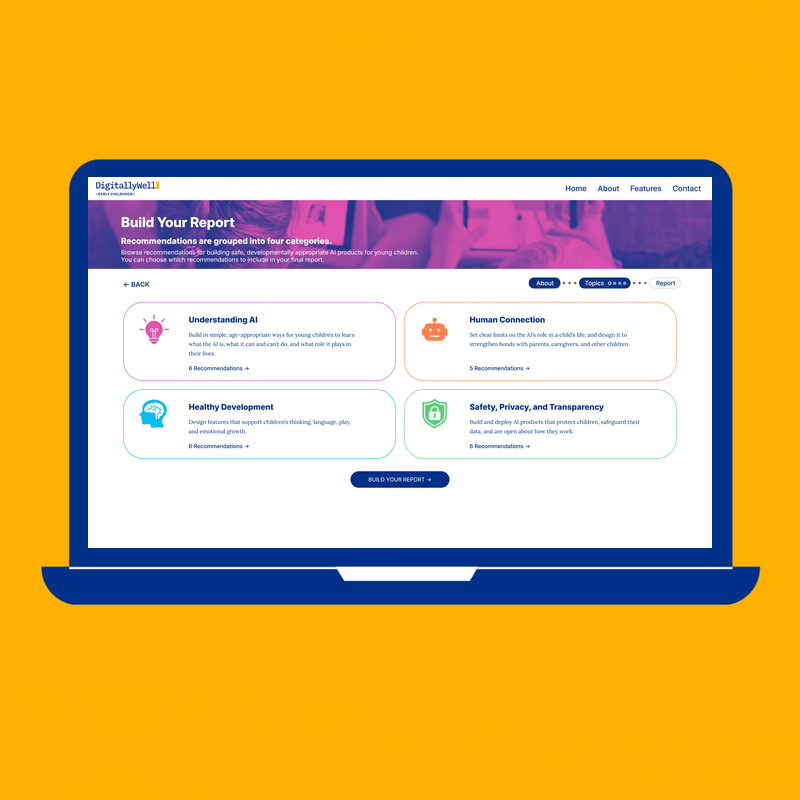
Four key areas that shape a young child’s experience with AI

Understanding AI
Help young children learn, in simple and age-appropriate ways, what the AI is, what it can and can’t do, and what role it plays in their lives.

Human Connection
Set clear limits on the AI’s role in a child’s life, and design it to strengthen bonds with caregivers and other children.

Healthy Development
Design features that support children’s thinking, language, play, and emotional growth.

Safety, Privacy, and Transparency
Build and deploy AI products that protect children, safeguard their data, and are open about how they work.
How It Works
Three easy steps to a report your team can use
Step 1
Tell us about your product
Share your role, the type of product you’re building, and your product development stage. You won’t be asked for proprietary details, and no identifiable information is collected.
Step 2
Review your recommendations
Based on your answers, we provide research-backed recommendations. Look them over and keep the ones that work with your product.
Step 3
Get your report
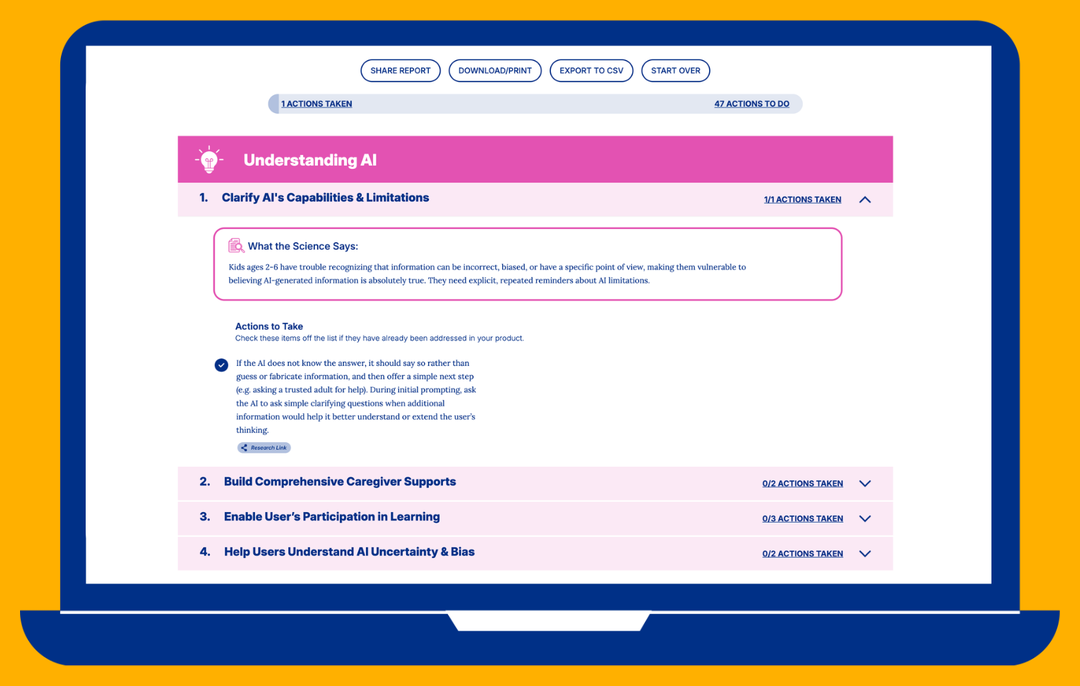
Download a personalized report of recommendations and action items to share with your team and revisit as your product develops.
Built for every stage of development
Use your personalized report in planning, design reviews, and conversations with stakeholders. If something changes, revisit the tool for guidance.
Who It's For
Made for the teams building products for young children
Your product type and development stage shape which recommendations you see.
Your role
Product Strategy UX Design Product Manager User Research Engineering Policy & Legal Trust & Legal Educator
Your product
Physical Toy/Robot Health Monitoring Device Tablet/Phone App Novel Screen Device Computer/Web App Novel Screen-Free Device Smart Speaker
Your stage
- Initial Concept & Discovery
- Design & Prototyping
- Development & Implementation
- Testing & QA
- Stakeholder Review
- Product Launch
- Post-Launch Updates
Our Process
Grounded in research. Written by humans.
DigitallyWell starts with global policy guidance, uses developmental science to turn it into concrete steps, and integrates the recommendations of experts in child development and safety.
Global guidance. We reviewed more than 30 policy and advocacy documents published between 2020 and 2025, from organizations including UNICEF, UNESCO, the OECD, and the World Economic Forum. Together, they contained more than 200 recommendations.
Developmental science. We combined those recommendations with research on how young children learn, how they treat technology as a social partner, how they think about what AI is, and the role of human interaction in early childhood.
Expert validation. At a 2025 workshop at Harvard’s Radcliffe Institute for Advanced Study, child development experts, product designers, and youth representatives reviewed the list and narrowed it to the guidance that matters most for young children.
Shaped by practitioners. Input from industry practitioners informed how the tool is designed to fit the way product teams work. DigitallyWell is not an AI-enabled tool. Researchers at the Lab wrote and reviewed every recommendation and action item. The tool supports design decisions and is meant to sit alongside user testing with young children and their caregivers.*
For the policy documents and research behind the recommendations, see the full reference list.
FAQ
Questions about DigitallyWell, answered
-
What is DigitallyWell?
DigitallyWell is a free web tool that helps product teams build developmentally appropriate AI experiences for young children. It provides research-backed, actionable recommendations based on what you're building.
-
Who is it for?
Anyone working on products for children ages 2 to 6, including individuals and teams in product strategy, product management, UX design, user research, engineering, policy and legal, trust and safety, and education.
-
What kinds of products does it apply to?
A wide range of AI-enabled products for young children, including physical toys and robots, tablet and phone apps, computer and web apps, smart speakers, health monitoring devices, and novel screen and screen-free devices.
-
Do I have to share details about my product?
No. You won’t be asked for proprietary details, and no identifiable information is collected.
-
What ages do the recommendations cover?
Children ages 2 to 6. Early childhood lays the foundation for lifelong learning, well-being, and success. We focused on this stage because more and more AI products for young children are coming to market.
-
How do you decide which recommendations I see?
We tailor recommendations to the information you share about your product, including its type and its stage of development. You then review them and choose the ones that apply.
-
Where do the recommendations come from?
We started with guidance from globally authoritative organizations, such as UNESCO, UNICEF, and the OECD, grounded it in developmental science, and refined it with child development experts, product designers, and youth representatives. Researchers at the Lab wrote every recommendation. None are AI-generated.
-
Does DigitallyWell certify products?
No. It does not certify, rate, or endorse products.
-
Does it cost anything?
No. DigitallyWell is free to use.
-
Will the recommendations be updated?
The recommendations are grounded in established principles of child development, digital well-being, and responsible AI design, so many are unlikely to change. AI and the research around it keep moving, though, and we plan to update the tool as new evidence, best practices, and user feedback come in.
About
Brought to you by
DigitallyWell was developed by the Digital Wellness Lab at Boston Children's Hospital, with technical development by FableVision Studios and financial support provided by the Esther A. & Joseph Klingenstein Fund.
Contact
Questions or feedback?
Have a question about DigitallyWell, or feedback on how it’s working for your team? Please email us at info@digitallywell.org.
*DigitallyWell does not use artificial intelligence to generate, personalize, or evaluate its recommendations. All guidance was developed and reviewed by researchers at the Digital Wellness Lab at Boston Children’s Hospital. This tool provides educational guidance only. It does not constitute medical advice, diagnosis, treatment, or formal regulatory certification. Use of this tool does not imply endorsement, approval, or a guarantee of compliance with legal or industry standards. It is designed solely as a resource to help creators navigate key developmental and safety considerations when designing AI products for young children. Always consult a healthcare provider for medical concerns.